The verification and review depth of Jama or Polarion, at the price of ReqView — hosted in the EU, with the AI the incumbents charge extra for. Built for hardware teams too small for DOORS and too serious for a spreadsheet.
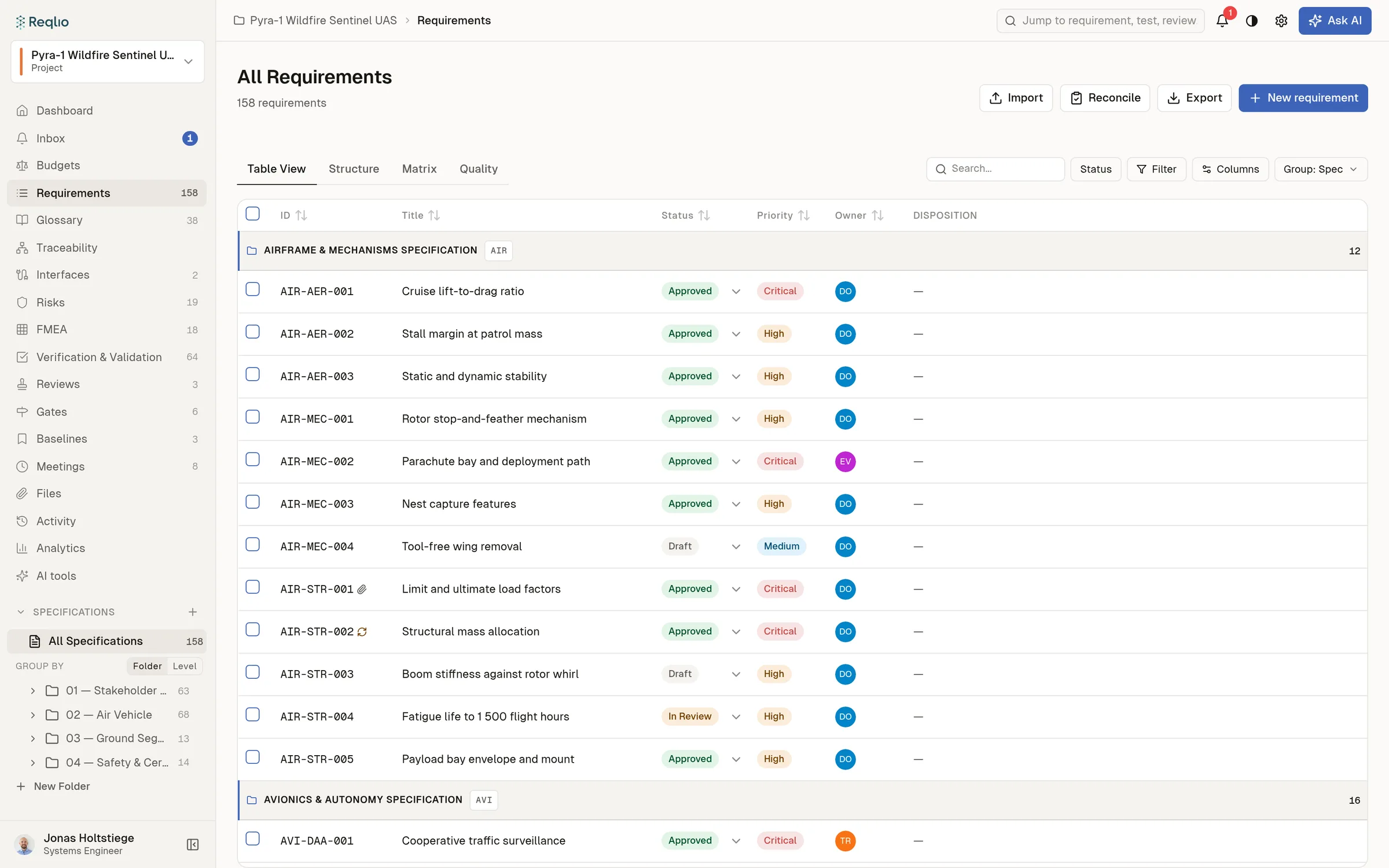
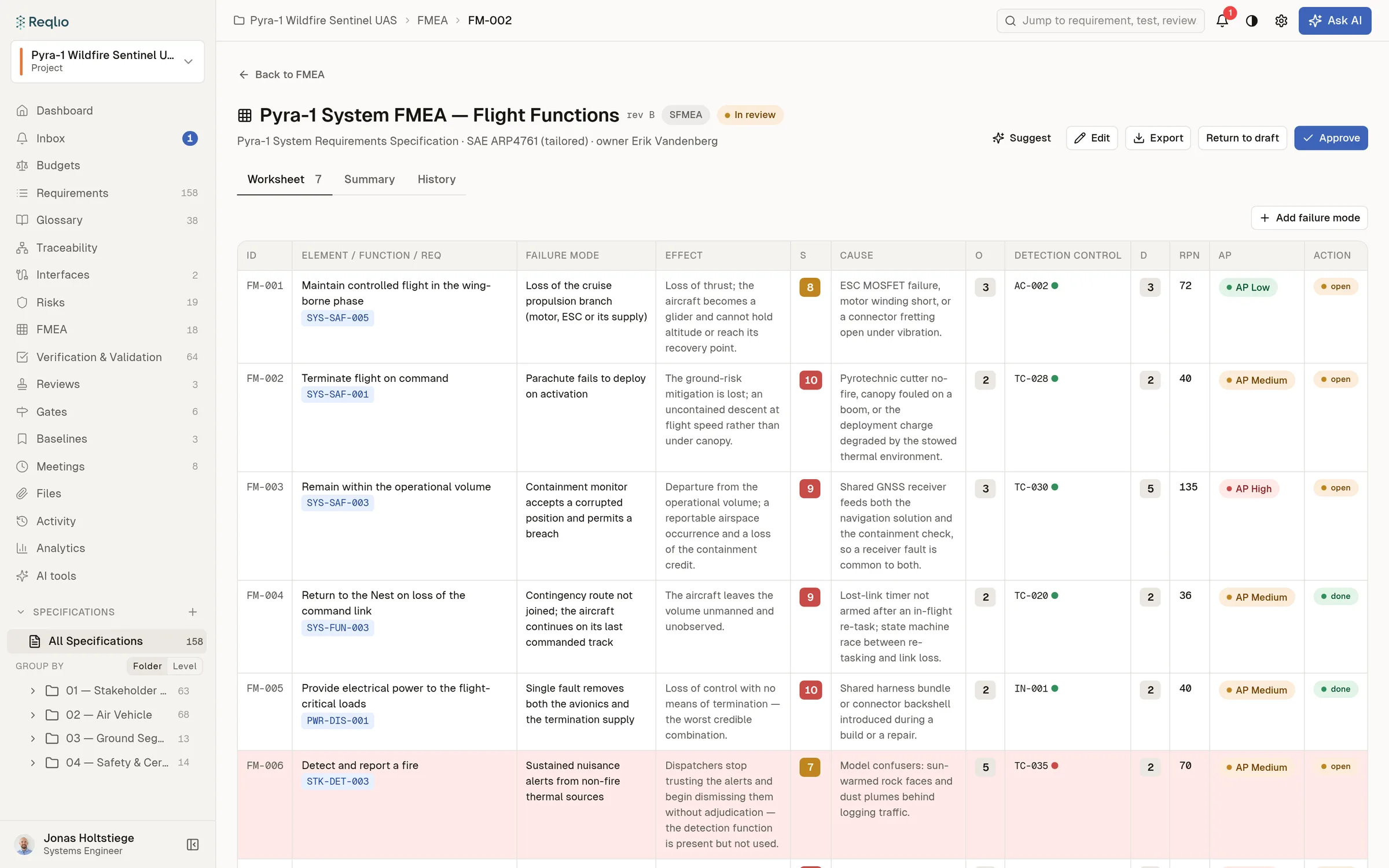
Not a requirements list with a traceability column. Verification activities with runs and coverage, campaigns, gates with readiness, risk register, FMEA, interfaces, technical budgets — the stack a small hardware team otherwise pays Jama or Valispace for.
INCOSE-style quality scoring with rewrites, decomposition, conflict detection, verification suggestions, risk and FMEA assistance, a project chat that cites requirement IDs — and an MCP server so Claude or any agent can work in your project. Bundled, with a generous monthly allowance.
Pay for the people who write. Approvers, stakeholders, viewers and supplier portal guests cost nothing, without limit. Sign-off is not a seat.
Servers in Germany, one PostgreSQL database per customer, data never leaves the EU by default. On Business, AI runs on an EU model endpoint of your choice.
Public prices. Thirty-day full trial without a card. Exports always available — ReqIF, XLSX, CSV. Read-only access to your data after cancellation. A continuity statement instead of a sales deck.
Excel can hold requirements. DOORS can hold budgets hostage. Reqlio gives small and mid-size hardware teams the full process — connected, current and reviewable.
ECSS-style document tree — stakeholder to component level — with sections, rationale, acceptance criteria and full history.
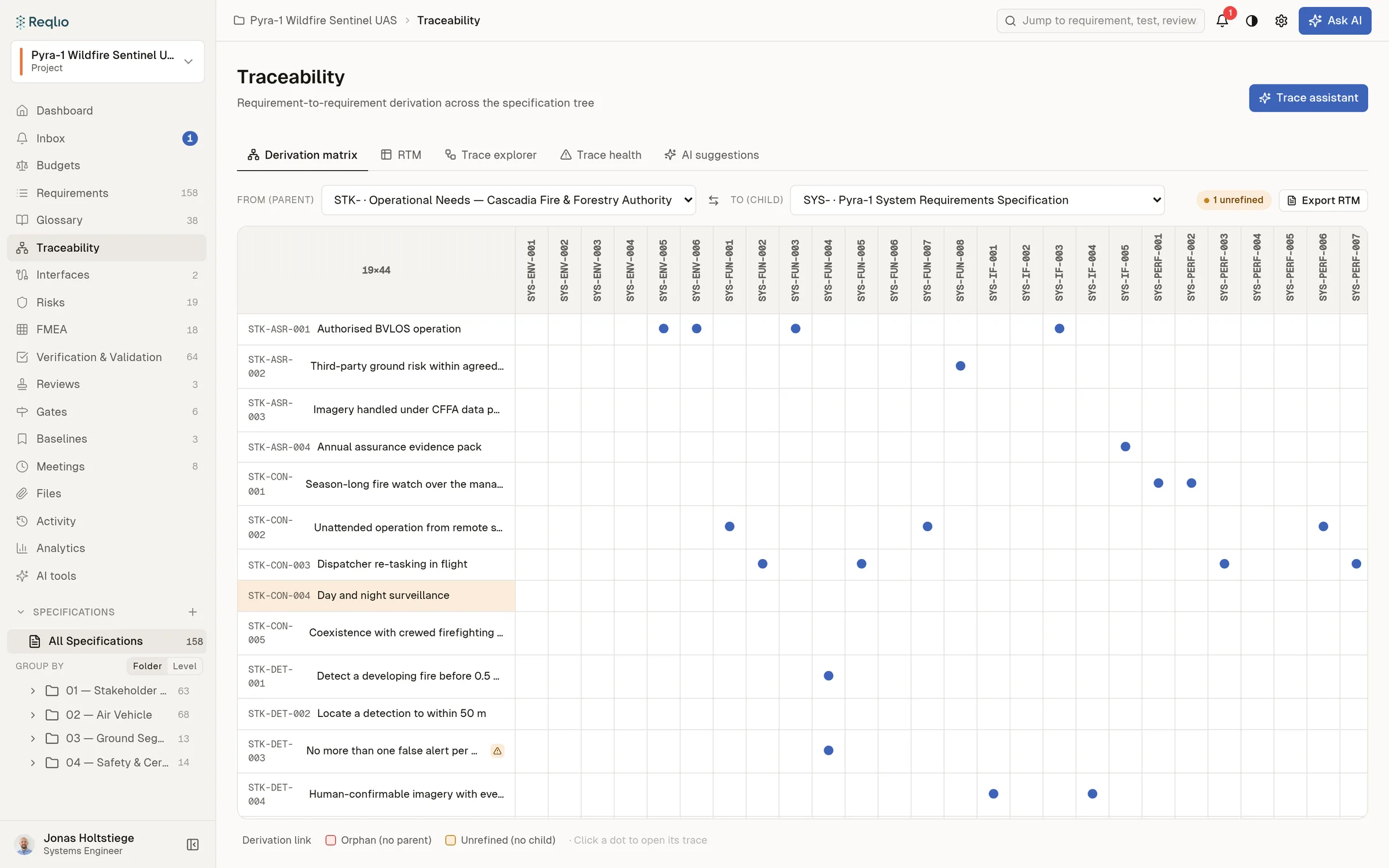
Derivation matrix, trace explorer and gap detection. Export a real RTM. Suspect links flag anything touched by change.
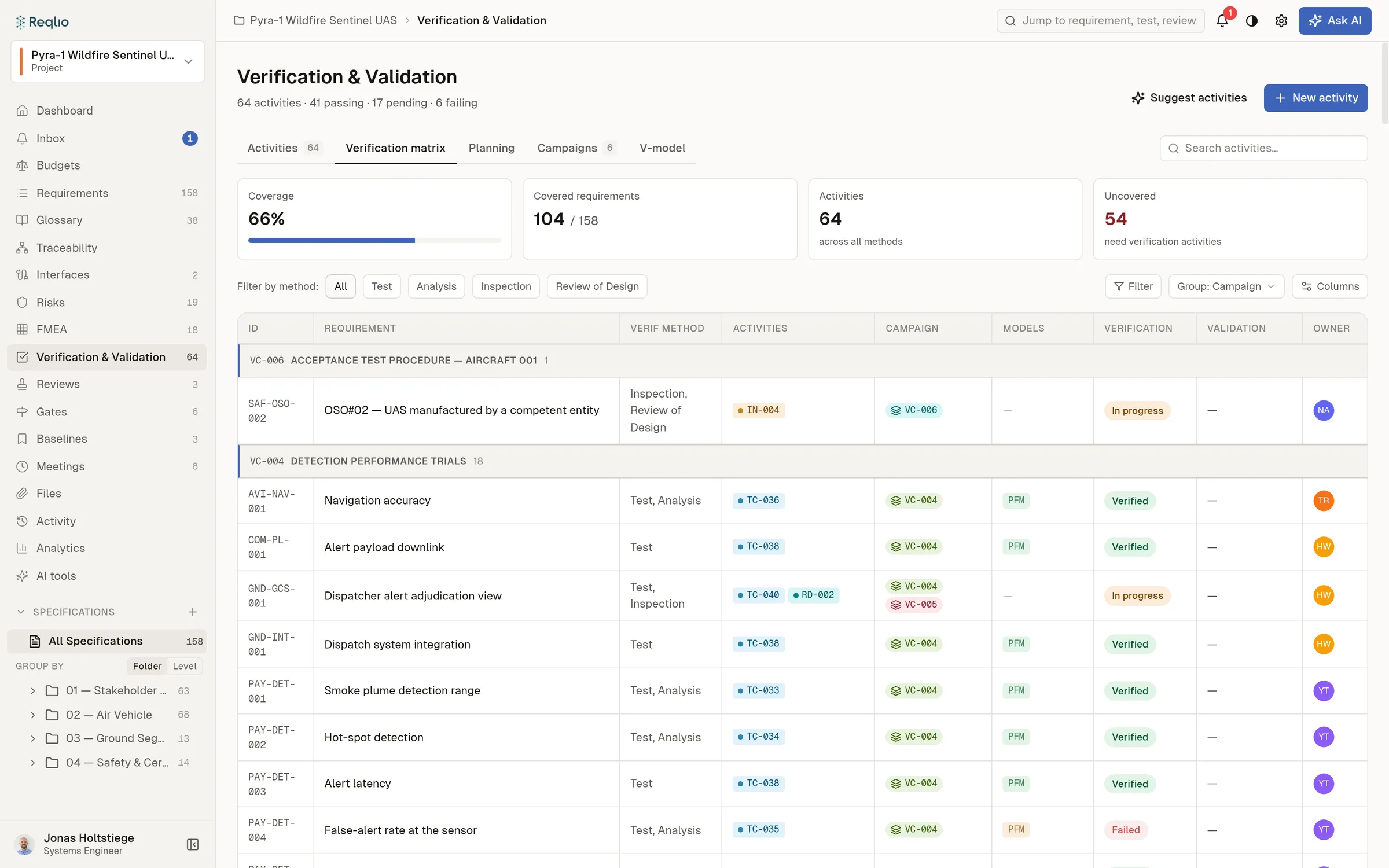
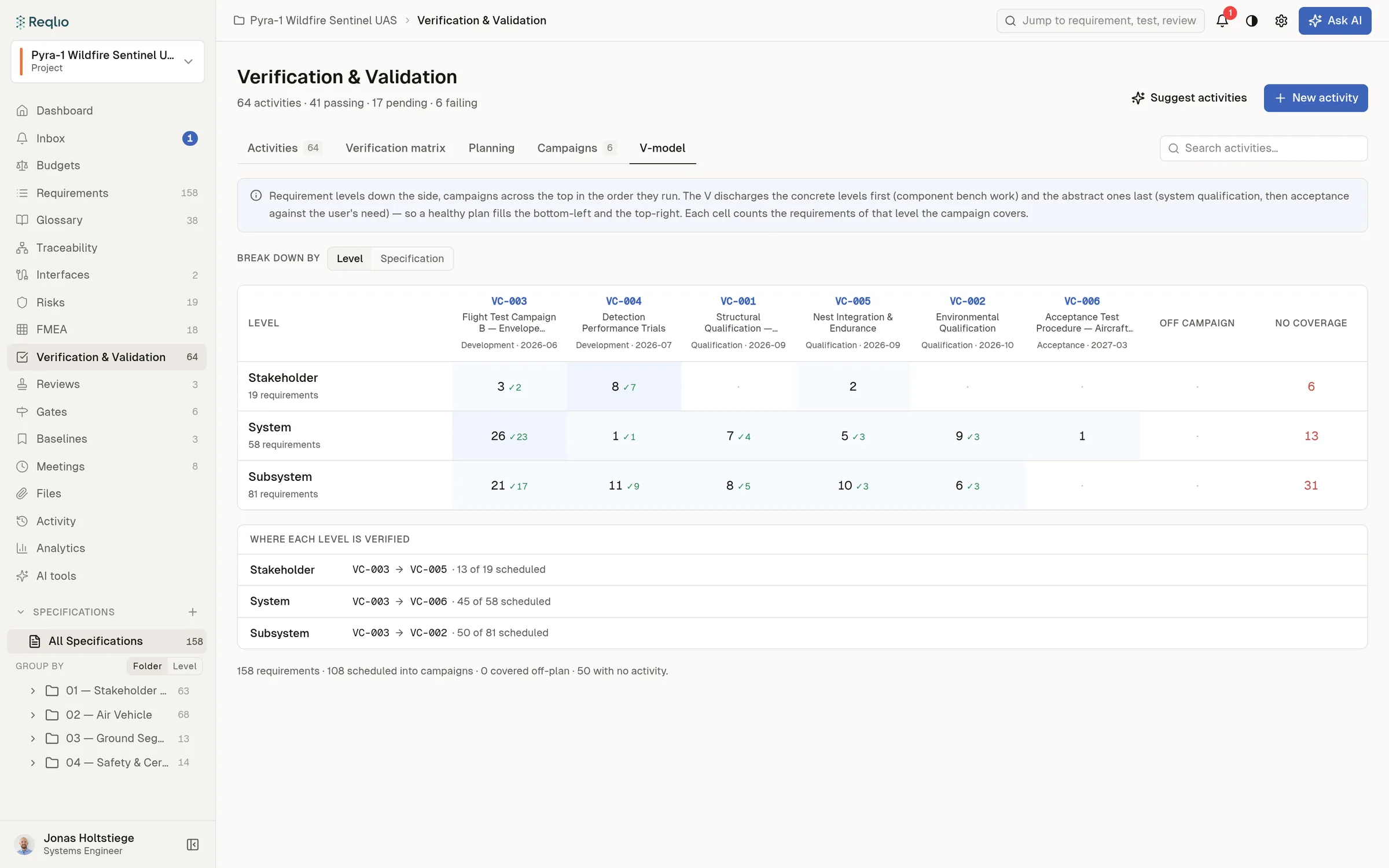
Test, analysis, inspection and review of design — planned on Kanban and timeline, grouped into campaigns that feed gates.
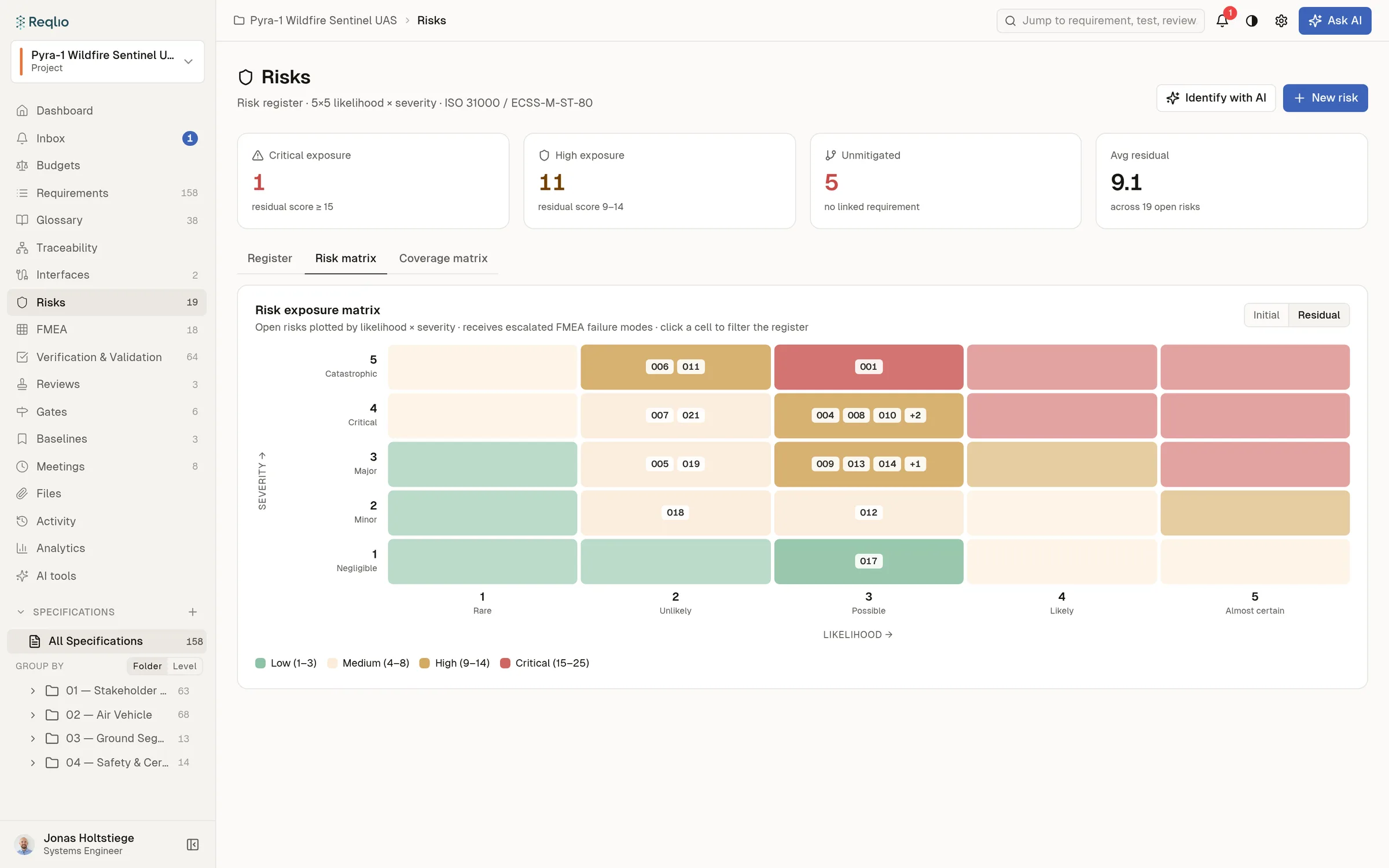
A 5×5 risk register plus AIAG-VDA FMEA worksheets — failure modes escalate to risks, mitigations trace to requirements.
Findings with dispositions, approval workflows that actually move requirement status, milestone gates and frozen baselines.
Comments with mentions, a personal inbox of everything awaiting you, meetings with action items — no email archaeology.
Every artifact links to the next, so status rolls up instead of living in someone's spreadsheet. Change one requirement and Reqlio flags everything downstream for re-review.
Captured in the StRD, AI-quality-checked
The SRD — derived & reviewed
Design specs with FMEA per scope
Your design & code — outside Reqlio
Test · analysis · inspection · RoD
Campaigns, reviews & gates
Validated, frozen per milestone
Structured specs with AI quality checks against INCOSE writing rules — ambiguity, missing criteria, duplicates.
Stakeholder → system → subsystem derivation, risks mitigated by requirements, gaps surfaced automatically.
Four ECSS methods, campaign planning, and verification status derived live from evidence — never hand-set.
Reviews close the loop, gates collect the evidence, baselines snapshot the agreed state for each milestone.


Not a chatbot bolted on — AI actions embedded in each module, running as background jobs while you keep working.
Scans statements against INCOSE rules: ambiguous quantifiers, missing acceptance criteria, compound requirements — with suggested rewrites.
Splits high-level requirements into testable children and proposes trace links you approve one by one.
Recommends test vs analysis vs inspection per requirement, drafts activities for uncovered ones.
Reads your spec and surfaces implied risks with severity estimates — reviewed and accepted by you, never silently added.
Proposes failure modes, effects and causes per function, pre-scored for the AIAG-VDA action priority table.
Builds your acronym and definition glossary from the requirement corpus, auto-highlighted in every statement.
Reqlio's data model isn't invented — it's lifted from the standards systems engineers already work to, so your process maps one-to-one.
Specification tree — technical requirements specifications by decomposition level, with rationale and acceptance criteria per requirement.
Four verification methods — test, analysis, inspection, review of design — with evidence-derived closure.
Writing-rule quality checks — the AI review enforces the INCOSE Guide to Writing Requirements characteristics.
FMEA with Action Priority — S/O/D scoring and the official AP table, escalating into the programme risk register.
Risk lifecycle — identify, assess, treat, verify, monitor, accept — with initial vs residual exposure.
Public prices, in euros, excluding VAT. Pay for the people who write — everyone who reviews, approves or reads is free, without limit.
Effective cost: four editors plus ten free stakeholders ≈ €17 per user per month. No free tier — a deliberate choice, so your vendor is still here next year.
Work email, no card. All modules, all AI. At day 30 the workspace goes read-only — not deleted — for another 60 days.
The first ten get Business features at the Team price, locked for as long as they stay.
50% off the first year for companies under two years old or under €2M raised.
€1,500 for 90 days for regulated teams — onboarding and one migration included, fully credited against the first annual contract.
Published per-editor prices, normalised to one editor / month on annual billing.
Anyone who creates or edits requirements, specs, activities, risks, FMEA rows or budgets, logs test runs, runs AI actions, or manages baselines and reviews. Reviewers — people who read, comment, vote and approve or request changes on review steps — are free, as are viewers and supplier portal guests. Sign-off is not a seat.
Your workspace goes read-only, not deleted, for another 60 days. Exports (ReqIF, XLSX, CSV) stay available the whole time. Pick a plan whenever you're ready; nothing is lost in between.
Always. ReqIF, XLSX and CSV export are available on every plan, at any time — including after cancellation, when you keep read-only access to your data for twelve months. On Enterprise, source-code escrow is available.
Hosted in Frankfurt, Germany, by creoline GmbH (ISO/IEC 27001:2022, TÜV SÜD) in firstcolo’s FRA4 data centre (ISO/IEC 27001:2022 with data-centre operation in scope, TÜV-certified data centre level 3), with one PostgreSQL database per customer. Data does not leave the EU by default. No model is trained on your data. The model provider keeps prompts briefly for abuse monitoring — 30 days on the default Anthropic models, up to 55 if you switch a project to Google’s. On Business you can bring your own EU model endpoint, so requirement text reaches neither.
Same concepts auditors expect — specification trees, four verification methods, baselines, RTMs, formal reviews — without months of configuration, a sales call to learn the price, or AI sold as a paid add-on. And the people who approve don't need a licence.
One engineer — German, based in the Netherlands, with a background in the aerospace industry — building the tool the incumbents refuse to. The verification campaigns, gates and budgets exist because they were missed on real programmes, not imagined in a product workshop. And that's why there's a written continuity statement instead of a sales deck: exports always on, read-only access after cancellation, escrow on Enterprise. Your data is never hostage to anyone's roadmap — including ours.
30-day full trial — every module, every AI action, no card. We set each workspace up by hand, usually within one working day — or book a 30-minute walkthrough first.